A price can be hiding a disappearing act.
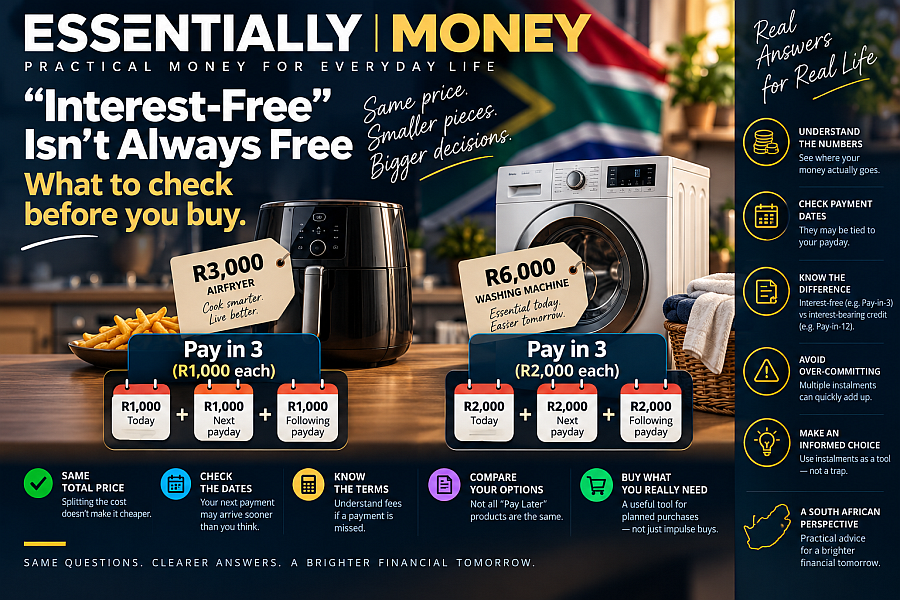
R3,000 sounds like a fairly substantial purchase.
R1,000 today sounds considerably less alarming.
And if the shop lets you take the item home immediately and pay the other R2,000 from your next two pay packets, the arrangement can be genuinely useful.
You haven’t made the product cheaper.
But you may have made the purchase considerably easier to manage.
There is an important difference.
Sometimes Interest-Free Really Does Mean Interest-Free
Let’s get something out of the way first.
Not every “buy now, pay later” offer is hiding a nasty surprise somewhere in the small print.
Some South African services genuinely allow you to split a purchase into instalments without charging interest or ordinary customer fees, provided you make the payments as agreed.
PayJustNow’s Pay-in-3 service, for example, allows a purchase to be divided into three payments at 0% interest. Payflex also offers interest-free instalment options where customers who pay according to the agreed schedule pay no interest or ordinary fees.
So if something costs R3,000, you make all the required payments and the total that eventually leaves your bank account is R3,000, then yes:
It really was interest-free.
That can be a very useful way of managing cash flow.
But there are still a few things worth understanding before pressing Buy.
R3,000 Has Somehow Become R1,000
Imagine you’re looking at a R3,000 appliance.
You might ask yourself:
“Do I really want to spend R3,000 on this?”
That’s a useful question.
Now put this next to it:
3 × R1,000
The product hasn’t changed.
Your income hasn’t changed.
The total price hasn’t changed.
But psychologically, the decision has.
You’re no longer being asked whether something feels worth R3,000.
You’re being asked whether you can manage R1,000 today.
There is nothing particularly sinister about that. Retailers want to sell things, and convenient payment options help them do it.
It is simply worth remembering that:
Splitting the price changes the payment. It doesn’t change the price.
“Pay in 3” Doesn’t Necessarily Mean Three Months Apart
This is an easy detail to miss.
With some Pay-in-3 services, later instalments are linked to your nominated payday rather than simply being collected exactly one and two months after the day you bought the item.
That can actually be very convenient because the payment arrives when your salary does.
But it can also make the second payment arrive sooner than you expected.
Suppose your nominated payday is the 25th and you make a purchase on 10 September.
Depending on the provider’s current scheduling rules, you could have something resembling:
10 September — R1,000
25 September — R1,000
25 October — R1,000
That first gap is only 15 days.
You haven’t been charged anything extra. Nothing has gone wrong.
But if you mentally translated “Pay in 3” into:
September → October → November
your budget may receive a small surprise.
The lesson is simple:
Check the actual debit dates shown when you make the purchase.
Don’t assume them from the number of instalments.
The Bigger Problem Starts When You Have More Than One
One R1,000 instalment might fit comfortably into your budget.
So might the R400 payment for something you bought last week.
And the R600 instalment for something else.
And the R350 debit you had almost forgotten about.
Individually, none looks particularly frightening.
Together:
R1,000 + R400 + R600 + R350 = R2,350
Suddenly R2,350 of your next salary has already been spoken for.
This is one of the less obvious risks of instalment shopping.
You may not feel as though you have accumulated conventional debt because there isn’t necessarily a large personal loan sitting in front of you.
Instead, you have accumulated future payments.
Your future salary doesn’t particularly care what we call them.
Interest-Free Doesn’t Mean Consequence-Free
The other condition is obvious but important:
You have to make the payments on time.
Interest-free instalment providers generally have rules covering failed or overdue payments. Depending on the particular service and agreement, missed payments can result in default charges and other consequences.
That doesn’t make an interest-free service expensive when used correctly.
It means “interest-free” describes the deal while you keep your side of it.
So before buying, check what happens if the debit order fails.
That matters particularly when payday, other debit orders and the instalment are all competing for the same bank balance.
Not Everything Called “Pay Later” Is the Same Thing
This is where things become particularly important.
A three-payment interest-free facility and a 12-month credit agreement are not the same product with different numbers of instalments.
PayJustNow, for example, also offers a Pay-in-12 facility powered by FinChoice. Unlike Pay-in-3, this is an interest-bearing credit arrangement, with the interest rate determined according to the credit agreement.
That doesn’t make Pay-in-12 automatically good or bad.
It makes it credit.
And that means it should be compared with other ways you might finance the purchase.
Look at the interest rate, fees, repayment period and — most importantly — the total amount you will eventually repay.
The convenient button presented at checkout isn’t necessarily the cheapest way to borrow money.
It isn’t necessarily the most expensive either.
You have to compare the numbers.
Cash Price Versus Instalment Price
Here is one of the simplest checks you can make.
Ignore the attractive instalment for a moment and look at the actual price.
If something costs R3,000 and the arrangement is:
R1,000 + R1,000 + R1,000 = R3,000
the arithmetic is straightforward.
But if you’re looking at longer-term finance, calculate what all the repayments add up to, including disclosed interest and fees.
This is the same principle we saw with longer-term personal loans.
A smaller repayment doesn’t necessarily mean cheaper money.
Sometimes it simply means you’re paying for longer.
“But I Was Going to Buy It Anyway”
And this is where interest-free instalments can be genuinely useful.
Suppose your washing machine dies.
Not “it has started making an interesting noise and perhaps we’ll replace it at Christmas.”
Dead.
There are clothes in it.
Naturally, it happens on Tuesday.
If the replacement costs R6,000, you need it now, and paying R2,000 from each of three pay packets fits comfortably into your budget, an interest-free facility may be a perfectly useful way of managing the purchase.
You’re managing cash flow.
That’s rather different from seeing a R6,000 television you hadn’t intended to buy and deciding:
“Well, it’s only R2,000 today.”
Same payment mechanism.
Different purchasing decision.
Before You Press Buy
Five questions are worth asking:
- What is the actual full price?
- How much leaves my account today?
- What are the exact dates and amounts of the remaining payments?
- What happens if one of those payments fails?
- Would I still buy this if the checkout showed only R6,000 instead of 3 × R2,000?
And if the offer involves interest or longer-term credit, add one more:
What is the total amount I will have repaid when this is finished?
That number is considerably more useful than the size of the first instalment.
The Essentially Bit
Interest-free instalments aren’t automatically a trap.
Used carefully, they can be a genuinely useful way of spreading a necessary purchase across several paydays without paying interest.
But splitting a price doesn’t reduce it.
And several individually manageable instalments can quietly turn into a fairly substantial claim on next month’s salary.
So don’t ask only:
“Can I afford today’s payment?”
Ask:
“How much of my next pay packet have I already spent?”
That is often the more useful number.
A quick note
This article provides general information for South African readers and is not personal financial, legal or tax advice. Financial products, fees, interest rates and individual circumstances vary. Check the terms that apply to you and, where necessary, seek advice from an appropriately qualified or registered professional.




One Comment