Compound interest sounds like something that should involve a calculator, a spreadsheet and possibly somebody wearing a tie.
It doesn’t.
The basic idea is remarkably simple.
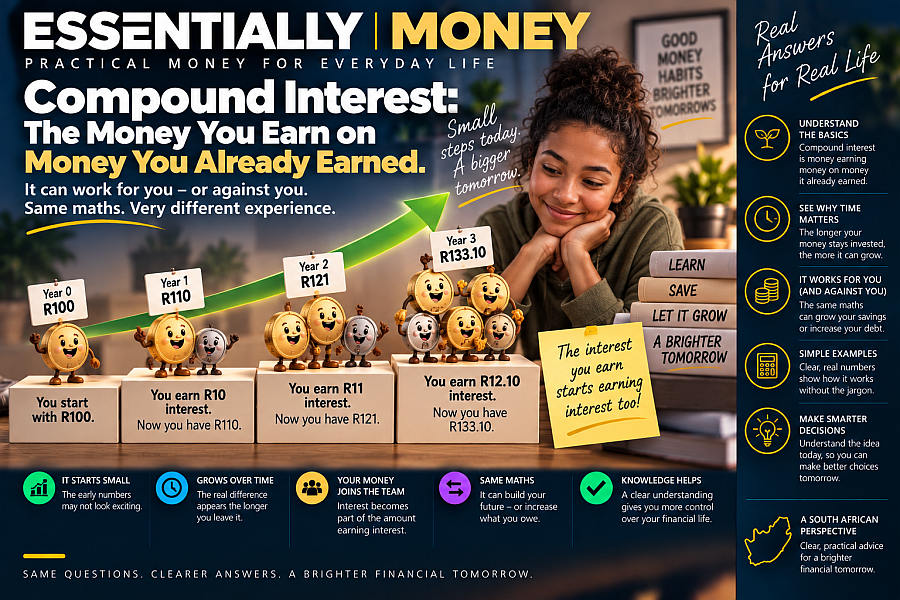
Imagine you have R100.
Your money earns 10% interest over a year.
At the end of the year, you’ve earned R10.
So now you have:
R110
Nothing particularly exciting has happened.
But leave the R110 where it is for another year.
This time you don’t earn 10% on R100.
You earn 10% on R110.
That’s R11.
Now you have:
R121
The extra R1 isn’t because the interest rate changed.
It’s because some of the money earning interest in the second year was interest you earned in the first year.
That’s compound interest.
Your Money Has Started Earning Money
Let’s keep going.
Start with R100 and assume, purely for illustration, that it earns 10% each year and everything stays where it is.
After one year:
R100 → R110
After two years:
R110 → R121
After three years:
R121 → R133.10
After four years:
R133.10 → R146.41
After five years:
R146.41 → R161.05
You haven’t added another cent.
The original R100 earned money.
Then the money it earned began earning money too.
Perhaps the easiest way to describe it is:
At first, your money does most of the work. Eventually, the money your money earned starts doing some of the work too.
Why Doesn’t It Look Very Impressive at First?
Because compounding needs time.
In our example, the first year’s interest was only R10.
After five years, R100 has become about R161.
Useful, certainly.
Life-changing? Probably not.
This is why compound interest can be so easy to underestimate.
At the beginning, the numbers look rather ordinary.
But continue the same imaginary example:
After 10 years, R100 would be about R259.
After 20 years, about R673.
After 30 years, about R1,745.
After 40 years, about R4,526.
Again, you haven’t added any more money.
The interest rate hasn’t increased.
What changed?
Time.
And with every passing year, there was a larger amount earning the next year’s interest.
What If the Interest Didn’t Compound?
This makes the difference easier to see.
Suppose your R100 earned R10 every year, but that R10 never joined the amount earning interest.
After 10 years, you’d have:
R200
Your original R100 plus ten lots of R10.
After 20 years:
R300
After 30 years:
R400
After 40 years:
R500
That’s simple interest.
Now compare that with our compound-interest example at the same illustrative 10% rate:
| Time | Simple interest | Compound interest |
|---|---|---|
| 10 years | R200 | about R259 |
| 20 years | R300 | about R673 |
| 30 years | R400 | about R1,745 |
| 40 years | R500 | about R4,526 |
That’s the bit people mean when they talk about the “power” of compound interest.
Nothing magical happened.
The interest simply remained in the pot and started earning interest of its own.
Why Time Matters So Much
Here’s something slightly surprising.
Look again at the compound example.
It took the original R100 approximately 25 years to grow to around R1,083.
Then it took only another seven years or so to roughly double again to around R2,111.
Why?
Because by then, it wasn’t R100 doing the work anymore.
There were more than two thousand rand doing it.
This is why starting earlier can make such a large difference when money is allowed to compound for a long time.
Not because young people’s money earns a special interest rate.
It simply gets more turns.
But Real Life Doesn’t Give You 10% Every Year
Correct.
Our 10% is there because it makes the arithmetic easy to see.
Real savings accounts and investments can have different rates, fees, taxes, risks and ways of calculating or crediting returns.
Some rates change.
Investment returns can rise and fall.
Inflation also matters because R1,000 decades from now won’t necessarily buy what R1,000 buys today.
So don’t read our R100 example as:
“Put money somewhere at 10% and this is what you’ll get.”
It isn’t a product recommendation or forecast.
We’re isolating one idea so that we can see how the maths works.
And the idea is simply:
returns can themselves begin generating returns.
It Works With Money You Add Regularly Too
Most people don’t put R100 somewhere and then stare at it for 40 years.
They add money.
Suppose you save something every month.
Each contribution has its own opportunity to earn returns.
The money you contributed years ago has had longer to compound.
Money you added last month has barely started.
Over a long period, your total can therefore consist of two quite different things:
money you put in
and
money that money went on to earn.
Eventually, depending on the return and how much time has passed, that second part can become surprisingly large.
That’s why time can be such an important ingredient.
Unfortunately, Compound Interest Has an Evil Twin
The maths doesn’t care whether the money belongs to you or somebody else.
Compound growth can work for you when returns are being added to your savings.
But similar compounding can work against you when unpaid interest is added to a debt and itself becomes part of the amount on which future interest is calculated, where the credit agreement and applicable rules allow it.
The principle is the same.
Imagine you owe R100 and, in our deliberately simplified example, 10% is added.
You now owe:
R110
If another 10% is then calculated on R110:
R121
Then:
R133.10
The arithmetic hasn’t suddenly become nasty.
You’ve simply changed sides of the table.
With savings:
Your money can earn money for you.
With debt:
Money you owe can increase the amount working against you.
That is why understanding compounding matters on both sides of your bank account.
The Formula Exists — But You Don’t Need It to Understand the Idea
If you eventually meet compound interest in a maths class, financial calculator or spreadsheet, you’ll find there is a formula for calculating it.
You don’t need the formula to understand what’s happening.
In ordinary English:
Start with some money.
Let it earn something.
Leave what it earned with the original money.
Next time, both amounts get the chance to earn something.
Then repeat.
That’s compound interest.
Why Starting Earlier Can Beat Starting Bigger
This is perhaps the most useful part to understand.
Imagine two people eventually put exactly the same amount of money aside.
One starts earlier and contributes gradually.
The other waits and tries to catch up later.
Depending on the returns and timing, the person who started earlier can have an enormous advantage because their earliest money has been given more opportunities to compound.
This isn’t a lecture about how everybody should have started saving at 18.
Real life intervenes.
Education costs money. Children need things. Houses need repairs. Jobs disappear. Salaries change.
Sometimes there simply isn’t spare money to save.
But it explains why time itself has financial value.
You can’t go back and buy another ten years of compounding later.
And That’s Why Tiny Beginnings Aren’t Necessarily Pointless
People sometimes think:
What’s the point of saving R100?
And if R100 is all you ever save and it sits somewhere earning almost nothing, that’s a fair question.
But the more useful habit may be learning that money doesn’t have to remain exactly the amount you put away.
You can add to it.
It can earn something.
What it earns can earn something.
And given enough time, the relationship between what you contributed and what you eventually have can become very different.
The important word isn’t necessarily big.
It’s time.
The Teenage Test
Try explaining compound interest to someone else without using the word compound.
If you can explain this:
“I earned some money on my money. I left that extra money there. Next time, I earned money on both.”
You’ve understood it.
Everything else is arithmetic.
The Essentially Bit
Compound interest is simply:
money earning money on money it already earned.
Start with R100.
Earn R10.
Leave it there.
Now R110 is doing the work.
Next time, the interest isn’t being calculated only on your original money. Some of yesterday’s earnings have joined the workforce.
And that leads to the two things worth remembering:
Compounding needs time.
And:
It doesn’t care which side you’re on.
When your savings are compounding, time can work for you.
When debt is compounding, time can work against you.
Same maths.
Very different experience.
A quick note
This article provides general information for South African readers and is not personal financial, legal or tax advice. Financial products, fees, interest rates and individual circumstances vary. Check the terms that apply to you and, where necessary, seek advice from an appropriately qualified or registered professional.