
A loan advertisement can perform a surprisingly effective bit of sleight of hand.
It takes a fairly large amount of money and turns it into a much smaller number.
R20,000 sounds like a lot.
R552 a month sounds considerably less alarming.
Both numbers can describe exactly the same loan.
The difference is that the first tells you how much you are borrowing. The second tells you only what you need to find each month.
And somewhere between those two numbers is the thing that matters just as much:
how long you will be paying it.
The Monthly Repayment Is Only Part of the Story
When most of us decide whether we can afford a loan, the obvious question is:
“Can I manage the monthly instalment?”
That is a perfectly sensible question.
It just shouldn’t be the only one.
Longer repayment periods reduce the amount you need to pay each month. That can make a loan easier to fit into an ordinary household budget.
But extending the repayment period also means that the outstanding balance remains around for longer — giving interest more time to accumulate.
So another question matters:
“How many of those instalments am I agreeing to pay?”
That is where a loan that looks affordable each month can become surprisingly expensive overall.
Let’s Put 22% Into Rands
Suppose you borrow R20,000 at an annual interest rate of 22%.
We’ll keep this first example deliberately simple.
We are going to ignore initiation fees, monthly service fees and credit-life insurance for a moment so that we can see what the interest and repayment term alone do to the numbers.
Using a standard reducing-balance loan calculation:
| Loan term | Approx. monthly repayment | Total repaid | Approx. interest paid |
|---|---|---|---|
| 12 months | R1,871.89 | R22,462.65 | R2,462.65 |
| 24 months | R1,037.56 | R24,901.51 | R4,901.51 |
| 36 months | R763.81 | R27,497.13 | R7,497.13 |
| 48 months | R630.12 | R30,245.83 | R10,245.83 |
| 60 months | R552.38 | R33,142.69 | R13,142.69 |
Same R20,000. Same 22% interest rate.
The only thing we changed was the repayment period.
And look what happens.
Going from 12 months to 60 months reduces the repayment from about R1,872 to R552 per month.
That feels dramatically more affordable.
But the approximate interest cost rises from R2,463 to R13,143.
By the end of the five-year loan, you have repaid about R33,143 for the original R20,000 — before we’ve even added the other costs that may apply.
That R552 suddenly looks a little different.
The Term Can Hide the Cost
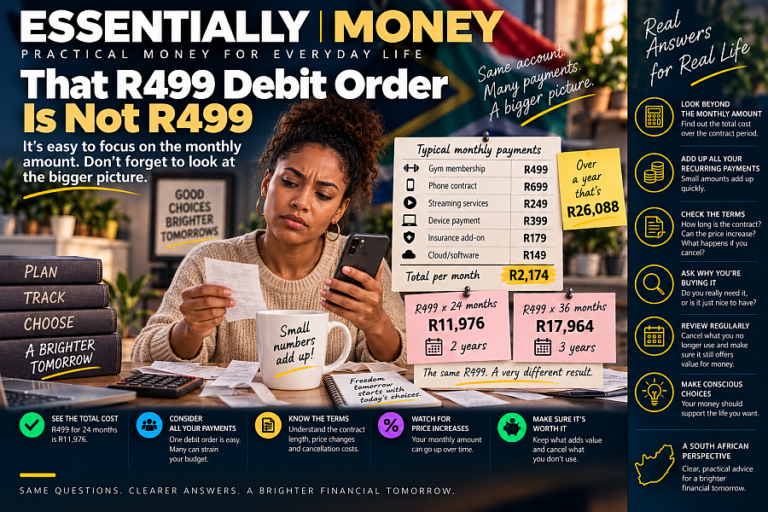
This is why comparing loans by monthly instalment alone can be misleading.
Imagine two offers:
Loan A: R1,038 per month
Loan B: R552 per month
At first glance, Loan B looks considerably cheaper.
But if Loan A lasts 24 months and Loan B lasts 60 months, they are not remotely the same financial proposition.
The lower instalment has not made the money cheaper.
It has simply spread the repayment over another three years.
There are circumstances where that may be useful. A household might genuinely need the lower monthly commitment.
But it should be a conscious trade-off:
lower monthly pressure in exchange for a higher overall cost.
Five Years Is Not Particularly Unusual Anymore
This isn’t a theoretical example involving some strange fringe lender.
Large South African banks now openly offer unsecured personal-loan terms extending well beyond five years.
Absa advertises personal loans from 12 to 84 months. Capitec offers repayment periods up to 84 months, while Standard Bank currently advertises terms extending to at least 72 months, with some of its personal-loan material also referring to terms up to 84 months.
So your 60-month personal loan may not look unusual at all.
That doesn’t mean it is automatically a bad loan.
It does mean you should know what those extra months are costing you.
And Interest Isn’t Necessarily the Whole Cost
Our R20,000 example deliberately isolates the effect of interest.
Real personal loans can include other regulated costs.
Depending on the agreement, those can include an initiation fee, monthly service fee and credit-life insurance.
Capitec provides a useful current example. It shows a R50,000 personal loan over four years at an annual interest rate of 22%. Once the initiation fee, monthly service fee and insurance in its representative example are included, the stated total cost reaches R84,811.
That doesn’t mean every R50,000 loan at 22% will cost R84,811.
Rates, fees, insurance premiums and individual offers differ.
It does show why simply multiplying the loan amount by the advertised interest rate does not tell you what you will ultimately pay.
But Doesn’t 22% Mean R4,400 a Year on R20,000?
Only if the full R20,000 remained outstanding for the entire year.
With a normal instalment loan, every repayment reduces the balance.
Interest is calculated on the outstanding amount, so as the capital falls, the rand amount of interest charged also changes.
That is why:
R20,000 × 22% × five years
is not the correct way to calculate the interest on an ordinary reducing-balance five-year loan.
You aren’t supposed to owe the full R20,000 for all five years.
The balance should progressively decline as you repay it.
Why Doesn’t the Instalment Fall Every Month Then?
Because most fixed-term personal loans are structured around a regular repayment.
At the beginning, a larger proportion of that repayment goes towards interest because the outstanding balance is higher.
As the balance falls, less interest accrues and a larger part of the same payment effectively goes towards reducing capital.
You don’t necessarily notice that happening because the debit order can remain much the same.
Behind it, however, the balance is changing every month.
The Real Number to Look For
This is why one of the most useful figures on a loan quotation isn’t necessarily the monthly instalment.
It is:
the total amount repayable.
The National Credit Act requires consumers entering covered credit agreements to receive a pre-agreement statement and quotation showing information including the principal debt, interest rate, instalments, fees, charges and the total amount payable.
That number answers a much more revealing question:
If I take this loan and simply make every scheduled payment until the end, how much money will actually leave my pocket?
That is the number worth comparing between offers.
A Lower Instalment Can Still Be the Right Choice
There is no useful financial advice in pretending everybody should simply choose the shortest possible repayment period.
Cars break.
Children need things.
Life has an irritating habit of ignoring budgets.
If R1,872 a month would leave a household unable to cope with ordinary expenses, a longer repayment term may be the more responsible choice even though it costs more overall.
The important distinction is between:
choosing the longer term because you understand the trade-off
and
choosing it because the only number you looked at was R552.
Those are very different decisions.
Before You Accept the Loan
You don’t need a spreadsheet.
Look at four numbers:
How much am I actually borrowing?
What interest rate am I being charged?
How many months will I be paying?
What is the total amount repayable, including the applicable costs?
Then ask yourself one final question:
Would I still think this was a good deal if the advertisement showed me the total repayment in the same size font as the monthly instalment?
That question has a way of clarifying things.
The Essentially Bit
A longer loan term doesn’t make borrowed money cheaper.
It makes the monthly repayment smaller.
Those are not the same thing.
On our simplified R20,000 loan at 22%, stretching the term from 12 months to 60 months cuts the monthly repayment by roughly R1,320.
But it adds roughly R10,680 more interest over the life of the loan.
If you need the lower repayment, that may still be a perfectly reasonable decision.
Just make it knowing what the extra months cost.
A quick note
This article provides general information for South African readers and is not personal financial, legal or tax advice. Financial products, fees, interest rates and individual circumstances vary. Check the terms that apply to you and, where necessary, seek advice from an appropriately qualified or registered professional.




One Comment