R499.
That’s not too bad.
It might be a gym membership. A phone contract. Fibre. Insurance. A subscription. Perhaps something considerably less exciting that nevertheless leaves your bank account every month.
Whatever it is, R499 sounds like R499.
And this month, it is.
But sign a 24-month contract and that R499 becomes:
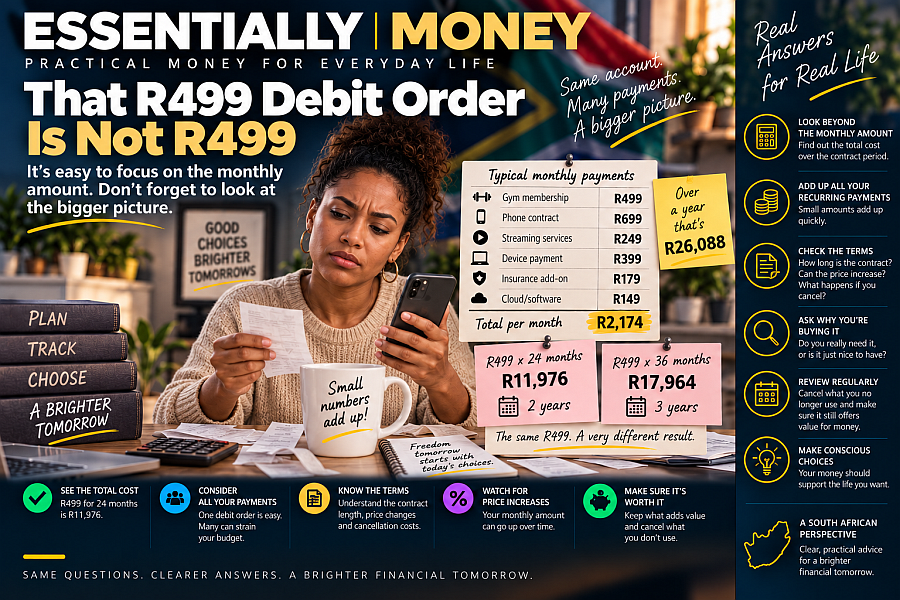
R11,976
Sign for 36 months and it becomes:
R17,964
Nothing sneaky happened to the arithmetic.
We simply stopped looking at the monthly number.
Monthly Prices Are Very Good at Looking Small
There is a reason so many products and services are advertised by monthly payment.
R499 per month
looks much friendlier than:
R11,976 over two years
Both can describe exactly the same commitment.
The monthly figure isn’t dishonest. In many cases it’s the most useful number for working out whether something fits into your budget.
But it answers only one question:
What will this cost me this month?
It doesn’t answer:
What am I committing myself to in total?
Those are different questions.
And sometimes you need both answers.
R499 × 24 Is Still R11,976
Let’s take a simple example.
You sign up for something costing R499 a month for 24 months.
Assuming the price doesn’t change and there are no additional fees:
R499 × 24 = R11,976
That doesn’t automatically make it a bad purchase.
If you’re getting two years of something useful for R11,976, you may decide that’s perfectly reasonable.
The important thing is that you’ve made that decision knowing you’re committing nearly R12,000, rather than thinking only about the R499 leaving your account next Tuesday.
The multiplication doesn’t tell you whether something is worth buying.
It tells you what you’re actually agreeing to.
The Real Fun Starts When R499 Gets Some Friends
Most of us don’t have only one recurring payment.
Imagine these are coming off your account every month:
| Commitment | Monthly amount |
|---|---|
| Gym | R499 |
| Phone | R699 |
| Streaming services | R249 |
| Device payment | R399 |
| Insurance add-on | R179 |
| Cloud/software subscription | R149 |
| Total | R2,174 |
None of those numbers looks particularly terrifying on its own.
Together:
R2,174 every month
That’s R26,088 a year.
Again, that doesn’t mean you should cancel them all, move into a cave and communicate by smoke signal.
You might use every one of them.
The point is simply that your bank account doesn’t see seven manageable little payments.
It sees R2,174 leaving.
Your Salary May Already Have Plans
This is where recurring payments become interesting.
Suppose payday arrives and R25,000 lands in your account.
Excellent.
Except some of that money may already belong, in practical terms, to commitments you made months or even years ago.
The phone contract is waiting.
The insurance debit order is waiting.
The gym is waiting.
The fibre provider is waiting.
Your streaming subscriptions have also remembered where you live.
By the time all the recurring payments have gone through, the amount of salary that was genuinely available for this month’s decisions may be considerably smaller than the number that appeared on payday.
That’s why looking only at individual debit orders can be misleading.
The more useful question can be:
How much of my monthly income is already committed before I do anything?
Not Every Recurring Payment Is a Contract
There’s another distinction worth making.
Some monthly payments are contractual commitments.
A 24-month phone contract, for example, may not simply disappear because you decide next month that you’d rather spend the money elsewhere. Cancellation terms, notice periods or settlement amounts may apply.
Others are subscriptions that you can cancel relatively easily.
And some expenses — insurance, fibre, security or medical-related services, for example — may be monthly expenses you deliberately expect to keep paying indefinitely.
They all appear as recurring payments.
But they aren’t necessarily the same kind of commitment.
That’s why R499 per month isn’t enough information by itself.
You also want to know:
For how long?
Can the price change?
Can I cancel?
What does cancellation cost?
Does it continue automatically?
Those questions can matter more than whether the monthly price is R449 or R499.
The R99 Problem
Oddly, the smallest recurring payments can be the easiest to ignore.
R79 here.
R99 there.
R149 for something you vaguely remember signing up for.
Perhaps R59 for an app whose principal function now appears to be sending you a receipt once a month.
Individually, they’re easy to dismiss.
Five small subscriptions averaging R100 each are:
R500 a month
or:
R6,000 a year
That doesn’t mean the correct response is to cancel every subscription.
If five R100 services give you R6,000 worth of enjoyment or usefulness over a year, wonderful.
But it’s worth occasionally checking that they still do.
“But I Can Afford R499”
You may well be able to.
That’s not really the problem.
The trap appears when we ask that question repeatedly.
Can I afford R499?
Yes.
Can I afford R299?
Probably.
What about another R199?
Sure.
R349?
That’s manageable.
Each decision is being compared with your income separately.
But the payments don’t arrive separately from your financial life.
They accumulate.
Affordable individually does not necessarily mean affordable collectively.
That is especially important with commitments that will still be there next month — and the month after that.
The Phone Contract Problem
Phones are a particularly good example because monthly pricing can make an expensive device feel surprisingly ordinary.
Imagine two offers:
R799 per month for 24 months
and
R999 per month for 36 months
The second number is only R200 more each month.
But the commitments are:
R799 × 24 = R19,176
versus
R999 × 36 = R35,964
Thirty-five thousand, nine hundred and sixty-four rand.
And perhaps the more interesting number is 36 months.
That’s three years.
Three years is a long commitment to a piece of technology. By the time the final debit order comes off, the phone that was brand new when you signed the contract will be three years old — and there will have been several generations of newer phones advertised to you in the meantime.
That doesn’t mean an expensive phone is automatically a bad decision. Perhaps its camera is important for your work. Perhaps you genuinely use capabilities that a cheaper device doesn’t offer. Perhaps you simply really like it and have decided it’s worth the money.
All perfectly reasonable.
But there’s another useful question:
Am I paying for something I genuinely value — or for what I hope owning it says about me?
There’s nothing particularly wrong with the second answer either.
We all buy things for reasons other than pure utility.
But R35,964 is enough money to be honest with yourself about why you’re spending it.
Monthly Affordability Still Matters
There’s an important balance here.
Total cost isn’t the only number that matters either.
Suppose something costs R12,000.
Paying R12,000 today and paying R500 a month for 24 months can have very different effects on a household’s cash flow.
For many people, the monthly structure is precisely what makes an expense manageable.
So the lesson isn’t:
Ignore the monthly payment and look only at the total.
It’s:
Look at both.
The monthly amount tells you whether the payment fits into your life now.
The total commitment tells you what that decision means over time.
You need both numbers to see the whole transaction.
Try the Payday Test
Here’s a useful exercise that doesn’t require a spreadsheet, budgeting app or sudden enthusiasm for accounting.
Look at the recurring payments that will leave your account between one payday and the next.
Add them up.
Not groceries.
Not petrol.
Not the electricity you’ll buy later.
Just the money that is already scheduled or committed to leave.
You may discover that a surprisingly large part of your salary has effectively been spent before payday arrives.
That number is useful.
Because the next time somebody offers you something for:
“Only R299 a month”
you aren’t asking whether R299 sounds small.
You’re asking whether you want to add another R299 to the pile.
Before You Sign Up
When you’re considering another monthly payment, ask:
What is the monthly amount?
How long will I pay it?
What is the total over that period?
Can the price increase?
Can I cancel, and what would that cost?
What other monthly commitments do I already have?
And perhaps the most useful question:
Would I still think this was good value if the total commitment were printed next to the monthly price?
That doesn’t make the decision for you.
It simply makes the decision easier to see.
The Essentially Bit
A R499 debit order really is R499.
This month.
But if you’ve agreed to pay it for 24 months, you’ve also made an R11,976 commitment.
And if it’s sitting alongside six other recurring payments, the more important number may be the total amount they’re taking from your income every month.
So don’t stop looking at monthly prices.
They’re useful.
Just add two more questions:
For how long?
And what does that make the total?
Because R499 sounds small.
R11,976 sounds like a decision.
A quick note
This article provides general information for South African readers and is not personal financial, legal or tax advice. Financial products, fees, interest rates and individual circumstances vary. Check the terms that apply to you and, where necessary, seek advice from an appropriately qualified or registered professional.