You’re buying a car.
Or perhaps applying for a home loan.
Eventually, somebody presents you with an interest rate that looks something like this:
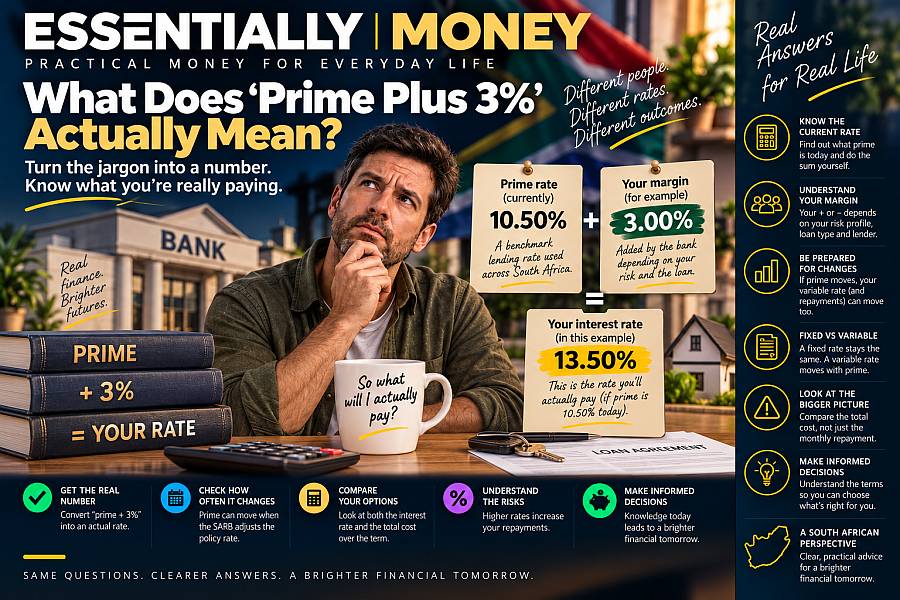
Prime + 3%
Excellent.
Except what does that actually mean?
Is prime a good interest rate?
Who decides what prime is?
Why are you paying more than prime?
And perhaps most importantly:
What number will actually appear in the calculation of your loan?
Fortunately, this is much simpler than the terminology makes it sound.
Let’s Turn It Into an Actual Number
South Africa’s prime lending rate is currently 10.50%.
So if you’re offered:
Prime + 3%
your current interest rate is:
10.50% + 3% = 13.50%
That’s it.
The 3% isn’t an additional charge calculated afterwards.
It simply means your interest rate is three percentage points above prime.
Likewise:
Prime + 1% = 11.50%
Prime = 10.50%
Prime − 0.5% = 10.00%
The arithmetic is the easy part.
What matters is understanding why your loan has been priced above or below prime — and what happens when prime changes.
First: What Is Prime?
Prime is a benchmark lending rate used throughout the South African banking system.
You will see it referenced particularly in variable-rate credit such as home loans and other lending products.
But there is a common misconception hiding in the name.
Prime isn’t necessarily the interest rate offered to the bank’s best customer.
In fact, SARB itself now says prime no longer really functions as the base rate from which banks price individual customers’ loans. Since 2001, it has effectively operated as an administrative reference rate set 3.5 percentage points above the SARB policy rate.
That’s a mouthful.
For ordinary purposes, think of prime as a ruler.
The bank can say:
Your rate = prime + 3
rather than having to quote a completely unrelated number every time interest rates change.
So Why Am I Prime Plus 3%?
This takes us back to something we saw in our previous MONEY article.
Banks don’t necessarily charge everybody the same interest rate.
They assess the particular loan and borrower.
Depending on the type of credit, factors can include your credit history, income, existing commitments, loan amount, repayment period, security behind the loan and the lender’s assessment of risk.
Someone might therefore be offered:
Prime − 0.5%
while somebody else receives:
Prime + 3%
and another person receives a considerably higher rate.
The important number isn’t whether your agreement says plus or minus.
It’s the actual interest rate you’re being offered.
At today’s prime rate:
Prime − 0.5% sounds like 10.00%.
Prime + 3% sounds like 13.50%.
Now you have numbers you can actually compare.
But Prime Can Move
And this is where things become more interesting.
If your loan has a variable interest rate linked to prime, the “+3%” part normally stays where it is.
Prime moves underneath it.
Imagine your agreement says:
Prime + 3%
With prime at 10.50%, you’re paying:
13.50%
Now suppose prime rises to 11.00%.
Your rate becomes:
14.00%
If prime later falls to 10.00%, your rate becomes:
13.00%
The bank hasn’t changed your personal +3% margin.
The benchmark it is attached to has moved.
That’s the important distinction.
Who Moves Prime?
This is where you’ll often hear people say:
“The Reserve Bank increased prime.”
That’s useful shorthand, but it isn’t quite what happens.
The South African Reserve Bank’s Monetary Policy Committee sets the SARB policy rate — the rate formerly commonly called the repo rate.
Prime then moves in relation to that benchmark.
At present:
SARB policy rate: 7.00%
Prime: 10.50%
That 3.5 percentage-point relationship has been fixed since 2001.
So when the policy rate moves, prime normally moves with it.
And if your variable-rate loan is linked to prime, your rate moves too.
A 0.25% Change Doesn’t Sound Like Much
This is where percentages can be deceptive.
Suppose you have a large home loan.
A rate movement of:
0.25 percentage points
looks tiny.
On a substantial balance being repaid over many years, however, even a small change in the interest rate can alter the monthly repayment and the total amount of interest paid.
And interest rates don’t necessarily move only once.
A sequence of increases can turn:
Prime + 1%
from a perfectly manageable repayment into a noticeably more expensive monthly commitment.
The reverse is also true.
When rates fall, borrowers with variable-rate loans can benefit because their interest rate — and potentially their required repayment — falls with them.
That is one of the fundamental differences between variable and fixed interest rates. Standard Bank’s own consumer explanation describes variable rates as moving with prime, while a fixed rate remains unchanged for the agreed period.
Fixed Versus Variable
Suppose you’re offered two choices.
One loan has a rate linked to:
Prime + 1%
The other has a fixed rate of:
12%
Which is better?
There isn’t enough information to answer that from those numbers alone.
If prime falls significantly during the loan, the variable option could become cheaper.
If prime rises significantly, the fixed rate might start looking rather attractive.
A fixed rate gives you certainty.
A variable rate gives you exposure to interest-rate movements — in both directions.
So “fixed” doesn’t automatically mean expensive, and “variable” doesn’t automatically mean better.
They’re different arrangements carrying different risks.
Don’t Confuse “Percent” With “Percentage Points”
Here’s a small distinction that will save some confusion.
If prime moves from 10.50% to 10.75%, it has increased by:
0.25 percentage points.
People commonly call that a “0.25% increase”, and everybody usually understands what they mean.
Technically, though, they’re different things.
Likewise, when we say:
Prime + 3%
we really mean:
Prime + 3 percentage points.
So:
10.50% + 3 percentage points = 13.50%
Not 10.815%.
If that last number made you briefly wonder whether you had accidentally opened a maths textbook, that’s precisely why percentage points are useful.
Is Prime Going Away?
Possibly — but not tomorrow.
In September 2026, SARB published a consultation paper proposing that South Africa eventually stop using the prime lending rate as the reference benchmark for lending and instead quote lending margins against the SARB policy rate.
In other words, something currently described as:
Prime + 3%
could eventually be expressed using the policy rate plus a larger margin.
SARB specifically says the intention is not to change the economic price of existing lending simply by changing the benchmark. The proposed transition would also require arrangements for existing contracts and isn’t expected to begin until after another major benchmark transition has been completed.
So there’s no reason to panic about your existing prime-linked home loan.
For now, prime remains very much part of everyday South African borrowing.
Before You Sign
If someone offers you credit at prime plus something, don’t stop at the attractive-looking formula.
Ask:
What is the actual interest rate today?
Is the rate fixed or variable?
If it’s variable, what benchmark is it linked to?
What is my margin above or below that benchmark?
What happens to my repayment if rates rise?
And, as always:
What will the loan cost me in total?
“Prime + 3%” is useful shorthand.
13.50% is considerably easier to understand.
The Essentially Bit
Prime isn’t a special interest rate reserved for important people.
It’s a benchmark.
When a bank says:
Prime + 3%
it is effectively saying:
“Whatever the prime benchmark is, your loan rate will sit three percentage points above it.”
Today, with prime at 10.50%, that’s 13.50%.
(SARB’s next MPC decision is due 23 September, so today’s 10.50% prime figure may change very shortly. So to be clear, at the time of writing, prime is 10.50%.)
If prime moves, your rate moves with it — assuming you have a variable prime-linked agreement.
So when comparing loans, don’t be intimidated by:
Prime plus this. Prime minus that.
Convert them into actual numbers.
Because “prime + 3%” sounds like banking.
“I’m paying 13.50% interest” sounds like money.
And that’s the number you actually need to understand.
A quick note
This article provides general information for South African readers and is not personal financial, legal or tax advice. Financial products, fees, interest rates and individual circumstances vary. Check the terms that apply to you and, where necessary, seek advice from an appropriately qualified or registered professional.