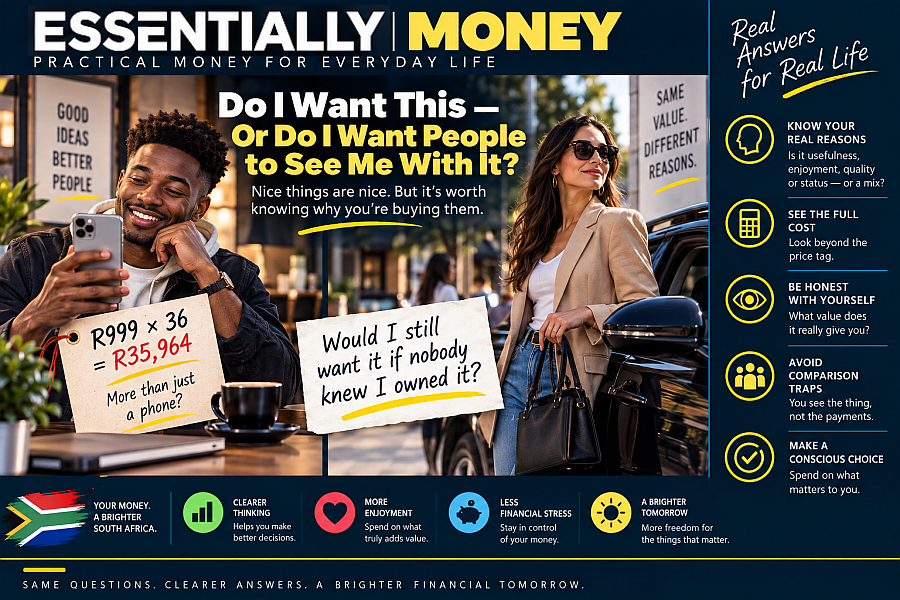
Imagine you’re looking at a new phone.
Your current phone works.
The battery still lasts most of the day.
It takes perfectly decent photographs.
Messages arrive.
Calls work.
Google Maps continues to know where you are, occasionally with rather more confidence than you do.
But there’s a new model.
It’s beautiful.
The camera is better.
The screen is brighter.
It does several things your current phone doesn’t do.
And it costs:
R999 per month for 36 months.
That’s R35,964.
So here’s an interesting question.
Do you want the phone?
Or do you want other people to see you with the phone?
Those Aren’t Necessarily the Same Thing
There’s nothing particularly strange about buying things partly because of what they say about us.
People have probably been doing it for as long as we’ve owned things.
Cars.
Clothes.
Watches.
Shoes.
Phones.
Houses.
Restaurants.
Even the coffee cup you’re carrying can sometimes say something about who you are — or who you’d like people to think you are.
We use possessions to express taste, success, interests, personality and belonging.
That’s human.
The financial problem doesn’t begin because you bought something other people might admire.
It begins when you don’t realise that’s part of what you’re paying for.
Sometimes the Expensive Thing Really Is Better
This is worth saying clearly.
A R25,000 phone may genuinely be better than a R5,000 phone.
A more expensive car may be safer, more comfortable, more reliable or simply much nicer to drive.
Good shoes can last longer.
A well-made appliance can be worth paying more for.
And sometimes the expensive version gives you pleasure every single time you use it.
That’s value too.
Money isn’t useful only when it’s being saved.
The point isn’t:
“Always buy the cheapest thing.”
The point is:
“Know why you’re choosing the expensive one.”
The Invisible Phone Test
Let’s try an experiment.
You’ve found the phone you want.
It costs R35,964 over the contract period.
Now imagine something peculiar happens.
Nobody will ever know what phone you own.
Your friends won’t see it.
Your colleagues won’t see it.
Nobody at the restaurant will notice when you put it on the table.
It will have no logo.
Nobody can ask you about it.
You still get the same camera.
The same performance.
The same screen.
The same features.
Would you still want it just as much?
If the answer is yes, excellent.
You’ve learned something useful about why you value it.
If the answer is no — or even “Hmm…” — you’ve learned something useful too.
Cars Make This Even More Interesting
Cars have an obvious practical purpose.
They get us places.
But very few people choose cars purely by calculating the cheapest possible cost per kilometre.
We care about comfort.
Safety.
Performance.
Reliability.
Appearance.
Brand.
How it feels to drive.
And, sometimes, how it feels when somebody else sees us driving it.
Again, none of those automatically makes the purchase foolish.
Suppose two cars both meet your practical needs.
One costs substantially more.
You prefer the expensive one because every morning when you walk into the garage, you think:
I love this car.
That’s a reason.
Perhaps you’re perfectly happy paying for that pleasure.
But suppose the strongest reason is:
People will know I’m doing well.
That’s a reason too.
The useful thing is recognising which one you’re buying.
Are We Buying the Thing — Or the Story?
Advertising rarely sells only the object.
A watch tells the time.
A car provides transport.
Clothes cover you.
A phone communicates.
If that were the whole story, marketing departments would have considerably shorter meetings.
Instead, products are often sold with a story attached.
Success.
Freedom.
Taste.
Adventure.
Youth.
Sophistication.
Belonging.
You’ve earned this.
People like you own this.
None of that means advertising is somehow controlling your mind.
You can see the story and still decide:
Yes. I want that.
But separating the thing from the story around the thing can make the decision clearer.
Social Media Has Made the Audience Much Bigger
Once, perhaps the neighbours saw your new car.
Your friends saw your clothes.
Your colleagues noticed your watch.
Now potentially hundreds or thousands of people can see what we’re eating, wearing, driving, visiting and buying.
That doesn’t mean everybody posting a holiday photograph is showing off.
Usually they’re just sharing their life.
But it does mean we live with far more opportunities to compare our lives with other people’s carefully selected moments.
And comparison can quietly change:
“That’s nice.”
into:
“Why don’t I have that?”
Those are very different thoughts.
The Problem Is That We Usually See the Thing — Not the Payment
Someone arrives in a beautiful new car.
You see the car.
You don’t see:
R9,500 per month
or:
71 payments remaining
or:
balloon payment at the end
or:
insurance
or:
the argument they had with themselves before signing the agreement.
You see the holiday photograph.
You don’t see whether it was saved for over two years, paid in cash, put on a credit card or financed somehow.
You see the expensive phone.
You don’t see payment 7 of 36.
That’s why comparing your financial life with somebody else’s possessions is particularly unreliable.
You’re comparing what you know about your money with what you can see of theirs.
Those aren’t remotely the same amount of information.
Sometimes Status Spending Is Deliberate
There’s another side to this.
Perhaps you genuinely enjoy luxury brands.
Perhaps cars are your hobby.
Perhaps fashion matters enormously to you.
Perhaps you collect watches.
Perhaps eating at wonderful restaurants is one of the great pleasures of your life.
Fine.
You don’t have to justify enjoying something simply because a cheaper alternative exists.
If you understand the cost, can accommodate it within your circumstances and have decided the enjoyment is worth it, you’ve made a conscious choice.
Essentially isn’t going to confiscate your nice watch and replace it with one from the supermarket.
The question isn’t whether somebody else thinks your purchase is sensible.
It’s whether you know why it is worth the money to you.
Where It Gets Expensive
The situation becomes more difficult when the purchase is being used to maintain an image that your finances are struggling to support.
The car payment is uncomfortable.
The phone contract has another 28 months to run.
The credit card balance is growing.
But stepping down feels like stepping backwards.
Not financially.
Socially.
That’s a surprisingly powerful pressure.
Because now you’re no longer deciding whether an object is worth its price.
You’re deciding what you think owning — or not owning — that object says about you.
And that can make an expensive decision feel compulsory when it isn’t.
Try the Nobody-Knows Test
Before a substantial purchase, try asking:
Would I still buy this if nobody else ever knew I owned it?
It isn’t a rule.
A wedding ring is meant to be seen.
Clothes are inherently visible.
A beautiful home is something you may enjoy sharing with other people.
The question is simply designed to separate two kinds of value:
What this gives me
and
what I hope this tells other people about me.
Both may be present.
Knowing the difference helps.
Then Ask the R35,964 Question
Remember our phone?
R999 × 36 months = R35,964.
Now the question becomes more useful.
Not:
“Is this phone too expensive?”
We can’t answer that for you.
Instead:
“What am I getting for my R35,964?”
Better photographs?
Performance you genuinely use?
A device you’ll enjoy every day?
Reliability?
Convenience?
Three years of showing people you have the latest model?
Perhaps some combination of all of them.
Once you can answer that, you can decide whether it’s worth R35,964 to you.
Your Money Doesn’t Know Whether Anybody Is Impressed
This is perhaps the wonderfully democratic thing about arithmetic.
The debit order doesn’t care why you bought something.
R999 leaves your account whether the phone is essential to your business or spends most of its life displaying WhatsApp messages.
The car instalment doesn’t become smaller because somebody admired the car at the traffic lights.
Money simply records the decision.
Which means the best person to decide whether the status, enjoyment, usefulness or quality was worth paying for is:
you.
But only if you’re willing to ask yourself the question.
The Essentially Bit
There’s nothing wrong with buying nice things.
There’s nothing wrong with enjoying brands.
And there’s nothing particularly unusual about caring what other people think.
We’re human.
But before spending a substantial amount, try separating:
What does this thing do for me?
from:
What do I hope this thing says about me?
Then ask:
Would I still want it if nobody else ever knew I had it?
If the answer is yes, you’ve learned something.
If the answer is no, you’ve learned something too.
Neither answer makes the decision for you.
It simply means you’re now deciding whether the thing is worth the money for the reason you actually want it.
And that’s a much better number to understand than the one on the price tag.
A quick note
This article provides general information for South African readers and is not personal financial, legal or tax advice. Financial products, fees, interest rates and individual circumstances vary. Check the terms that apply to you and, where necessary, seek advice from an appropriately qualified or registered professional.