You have a credit card.
There’s a phone contract.
The car is financed.
You bought something on Pay-in-3.
There’s still a balance on the store account.
And somewhere in the background, a personal loan quietly removes its instalment every month.
None of these necessarily looks alarming.
The credit card payment is manageable.
The phone contract fits the budget.
The Pay-in-3 purchase is interest-free.
The car payment was carefully considered.
The store account isn’t very large.
The personal loan has been there for ages.
Look at each one separately and everything may appear perfectly reasonable.
But there’s another question worth asking:
How many different ways are you currently paying for things?
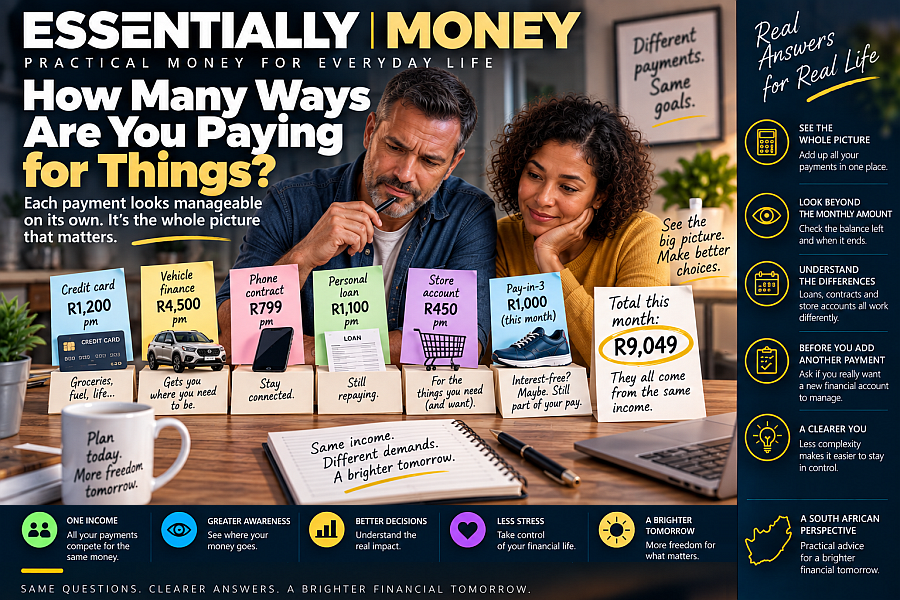
One Person. Six Different Payment Arrangements.
Imagine someone has these:
Credit card: R1,200 a month
Vehicle finance: R4,500 a month
Phone contract: R799 a month
Personal loan: R1,100 a month
Store account: R450 a month
Pay-in-3 purchases: R1,000 due this month
None of those figures necessarily looks disastrous on its own.
Together:
R9,049
That’s the number your bank account experiences.
It doesn’t care that one payment is called vehicle finance, another is revolving credit and another arrived with a cheerful “interest-free” label.
They’re all competing for money from the same income.
Every Provider Sees Its Own Payment
This is part of what makes multiple credit arrangements difficult to see clearly.
The phone company tells you:
R799 per month
The vehicle-finance agreement tells you:
R4,500 per month
The store tells you:
R450
The Pay-in-3 service says:
R1,000 on your next payday
Each number arrives in its own little box.
Nobody sends you a message saying:
“By the way, when you add us to everything else, you’re paying R9,049 this month.”
That’s your calculation to make.
Manageable Isn’t the Same as Simple
You might genuinely be able to afford all six payments.
That’s important.
This article isn’t based on the idea that having several forms of credit automatically means you’re in financial trouble.
You could have sufficient income, make every payment on time and be completely comfortable.
But affordability is only part of the picture.
There’s also complexity.
Six arrangements can mean six payment dates.
Six balances.
Six sets of terms.
Different interest rates.
Different fees.
Different settlement rules.
Different consequences if something goes wrong.
Perhaps several apps, statements and passwords as a bonus.
Your finances can become difficult to manage long before they become impossible to afford.
Some of Them Behave Very Differently
A credit card isn’t the same thing as vehicle finance.
A Pay-in-3 purchase isn’t the same thing as a personal loan.
A phone contract isn’t necessarily even a conventional loan, although part of what you’re paying may relate to a device supplied over the contract period.
A store account may offer revolving credit.
A vehicle-finance agreement has a completely different structure.
That’s why simply adding the monthly payments together tells you something useful — but not everything.
You also need to know what each payment actually is.
Which brings us to a surprisingly useful exercise.
Make a Payment Map
Not a budget.
Not a spreadsheet containing 47 categories and a pie chart showing that you spent R83 too much on cheese.
Just one list.
Write down every arrangement where you’re currently paying for something over time.
For example:
| Payment | Monthly amount | Balance left | Ends when? |
|---|---|---|---|
| Credit card | R1,200 | R18,000 | No fixed end |
| Vehicle finance | R4,500 | R145,000 | Aug 2029 |
| Phone contract | R799 | — | Mar 2028 |
| Personal loan | R1,100 | R22,000 | Nov 2028 |
| Store account | R450 | R4,800 | Depends on repayments |
| Pay-in-3 | R1,000 | R2,000 | Nov 2026 |
The numbers are illustrative, but look what has happened.
We’ve turned:
“I have a few payments.”
into something you can actually see.
You know what’s leaving every month.
You know roughly what is still outstanding.
And you know which commitments have an end date.
That alone can make the picture considerably clearer.
“Balance Left” Can Be More Useful Than “Monthly Payment”
This connects directly with several of our earlier MONEY articles.
A small monthly payment can hide a large balance.
A long loan can make a substantial debt look affordable.
A minimum credit-card payment can keep a balance hanging around.
An interest-free instalment can still occupy part of your next salary.
The monthly payment matters because you have to pay it.
But the remaining balance and remaining time tell you something the monthly number can’t.
They tell you how much of the commitment is still ahead of you.
Then Something New Arrives
This is where the payment map becomes particularly useful.
Suppose you’re considering another purchase for:
R699 per month
Viewed alone, R699 may fit comfortably into your income.
But you’re no longer viewing it alone.
You can see the other six arrangements.
Now the question isn’t merely:
“Can I afford R699?”
It’s:
“Do I want a seventh payment arrangement?”
Those aren’t quite the same question.
Perhaps the answer is yes.
Perhaps the new purchase is important and the payment is easily manageable.
But now you’re deciding with the whole picture in front of you.
The Problem With Future You
When we spread payments over time, we’re making decisions about money we haven’t earned yet.
That’s not automatically a problem.
Most of us couldn’t buy a house by waiting until we’d saved the entire purchase price in cash.
Financing exists for a reason.
But every future payment makes a small claim on future income.
Your car payment has booked its place in November.
So has the phone.
So has the personal loan.
The Pay-in-3 purchase has reserved a seat too.
And then November actually arrives.
Unfortunately, November may have developed ideas of its own.
The car needs tyres.
The geyser develops an interesting new relationship with the ceiling.
A child announces something at school costs R1,800 and apparently everybody has known about it except you.
Future income always looks wonderfully available until the future becomes the present.
One More Payment Can Be Easy to Add
This is particularly true when the new payment uses a different method.
You might hesitate before adding R3,000 to your credit-card balance.
But:
R1,000 today
R1,000 next payday
R1,000 the payday after that
can feel like a completely separate decision.
Technically, it is.
Financially, all those commitments eventually meet in the same place:
your bank account.
That’s why knowing how many payment arrangements you already have can be as useful as knowing their individual costs.
Does Putting Everything in One Place Solve It?
Not necessarily.
Combining debts or moving balances can sometimes simplify administration, but it can also change interest rates, fees, repayment periods and total cost.
A single payment isn’t automatically cheaper than five payments.
And five payments aren’t automatically worse than one.
The useful principle is simpler:
Complexity has a cost too.
Not necessarily a cost measured in rands.
A cost in attention.
Remembering dates.
Checking balances.
Understanding statements.
Noticing when something changes.
And making sure nothing quietly carries on for much longer than you intended.
A Small Balance Still Deserves a Place on the List
There’s a temptation to ignore the little ones.
R700 left on a store account.
One final Pay-in-3 instalment.
A small credit-card balance.
They don’t feel important enough to include.
Include them anyway.
The purpose of the payment map isn’t to frighten yourself with a giant total.
It’s to create one place where the whole picture exists.
Some entries may disappear next month.
Good.
Cross them off.
There’s something rather satisfying about a financial commitment reaching zero and leaving the page altogether.
Before You Add Another Way to Pay
When you’re considering another credit arrangement or instalment plan, ask:
How much will I pay each month?
How long will I pay it?
What’s the total cost?
What balance will I owe?
What other payment arrangements do I already have?
And then add one question we don’t often ask:
Do I want another financial account to manage?
Sometimes the answer will be yes.
But it’s worth asking.
The Essentially Bit
Having several ways of paying for things doesn’t automatically mean you’re overextended.
The problem is that each arrangement tends to present itself separately.
R799 here.
R450 there.
R1,000 next payday.
R1,200 on the credit card.
Each can look manageable on its own.
So every now and then, put them in one place.
List the payment.
List what’s still owed.
List when it ends.
Then look at the whole thing.
Because your finances don’t exist in six different apps, statements and contracts.
They all belong to the same you.
A quick note
This article provides general information for South African readers and is not personal financial, legal or tax advice. Financial products, fees, interest rates and individual circumstances vary. Check the terms that apply to you and, where necessary, seek advice from an appropriately qualified or registered professional.