Electricity is expensive, but saving it doesn’t necessarily mean buying solar panels, replacing every appliance in your house or sitting in the dark.
Sometimes the cheapest electricity-saving device is simply a switch that knows when to turn something off.
Geysers and pool pumps are among the heavier electricity users in many South African homes. They can also create unnecessary demand if they operate when nobody needs them. For homes with solar and battery backup, timing becomes even more important: a geyser or pool pump switching on at the wrong time can turn a comfortable battery reserve into a rapidly falling percentage.
The solution is surprisingly simple: timers and smart switches.
Used properly, they let you decide when electricity is consumed rather than simply allowing appliances to decide for themselves.
1. Smart Switch or Old-Fashioned Timer?
Traditional timers are certainly not useless. A good timer can be a simple, reliable and inexpensive way to control an appliance.
Their weakness becomes apparent when schedules need changing or after power interruptions. Depending on the type of timer and its backup system, its clock can drift or reset. Eskom specifically recommends checking geyser and pool-pump timer settings after outages.
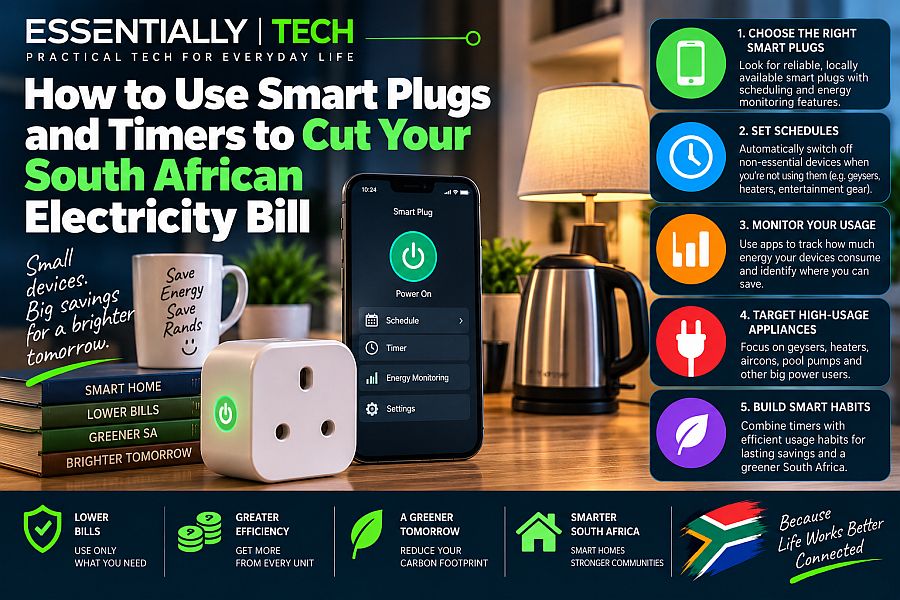
A Wi-Fi smart switch adds some useful tricks:
- schedules can be changed from your phone;
- devices can be switched remotely;
- many models restore their schedules automatically;
- some provide energy-consumption information; and
- automations can be based on time, sunrise/sunset or other conditions.
For something simple such as a lamp, fan or small appliance, a plug-in smart socket may be all you need.
For geysers, pool pumps and other high-current or fixed appliances, don’t assume that an ordinary smart plug is suitable. Use equipment correctly rated for the load and have fixed electrical work done by a registered electrician.
2. Start With the Geyser
If you’re looking for one appliance worth managing intelligently, the geyser is an obvious candidate.
The important point, however, isn’t that a geyser should always run for a particular number of hours. Every household is different. A family of five taking morning showers has a very different hot-water profile from one person who showers at night.
Instead, start by asking:
When do we actually need hot water?
Then build the schedule around that.
If You’re Using Grid Electricity
Rather than leaving the geyser available to reheat water throughout the day, experiment with scheduled heating periods before your household’s main hot-water demand.
For example, a household that showers in the morning and evening might begin with a heating period before each of those times and adjust it according to experience.
There is another South African consideration: peak demand.
Eskom identifies roughly 17:00 to 21:00 as the country’s major evening electricity-demand period and specifically encourages households to reduce heavy loads such as geysers and pool pumps during constrained periods.
So where practical, heat the water before the evening peak rather than during it.
If You Have Solar
This is where scheduling gets really interesting.
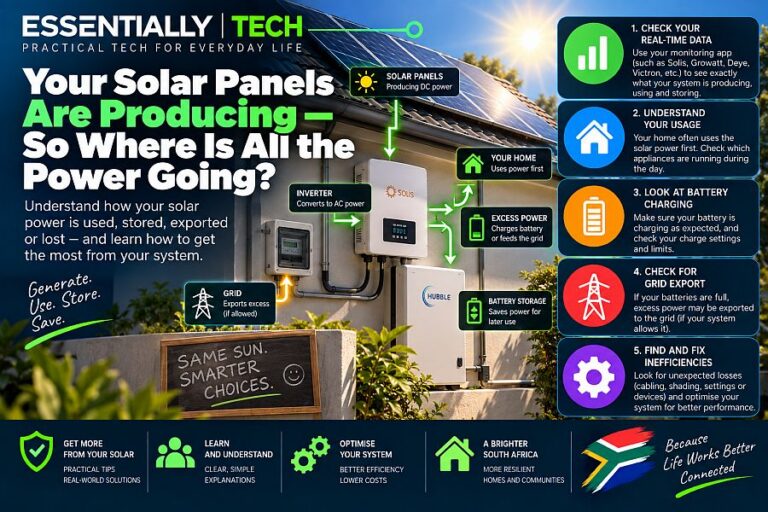
If your PV system is producing surplus electricity during the middle of the day, your geyser can effectively become a form of thermal energy storage.
Instead of sending solar power into the geyser at night from your battery, schedule water heating for the part of the day when solar production is strong.
For many installations that will be somewhere around late morning to early afternoon, although the ideal window depends on the season, weather, orientation of your panels and size of your solar system.
You’re effectively storing some of the day’s solar energy as hot water instead of battery charge.
That can be a very useful trick.
3. Put the Pool Pump on a Schedule Too
A pool pump is another appliance that can quietly consume electricity for hours simply because nobody has reconsidered its timer for years.
The correct runtime isn’t identical for every swimming pool. Pool volume, pump size and flow rate, season, water temperature, pool usage and whether the pool is covered all matter.
So don’t blindly copy somebody else’s four-hour schedule.
Instead, find the shortest practical filtration period that keeps your particular pool clean and healthy, and adjust it seasonally.
Eskom also recommends keeping pool-pump operation outside the 17:00–21:00 evening peak and notes that runtime can often be reduced when a pool is not being used.
Solar Homes Have Another Advantage
If you have solar, schedule the pool pump during daylight hours.
That allows the pump to consume PV generation directly rather than using stored battery energy later.
And if you are running both a geyser and pool pump from an inverter system, it can make sense to stagger heavy loads rather than having everything switch on simultaneously.
You don’t necessarily need an arbitrary two-hour gap — the important thing is to stay within the continuous and surge capabilities of your inverter and electrical installation.
For example:
10:00–12:00 — Geyser
12:00–16:00 — Pool pump
The exact times aren’t important. The principle is.
4. Smart Plugs Aren’t Just for Big Appliances
This is where the article title really starts earning its keep.
Walk through your home and look for things that are running when nobody actually needs them.
Candidates can include:
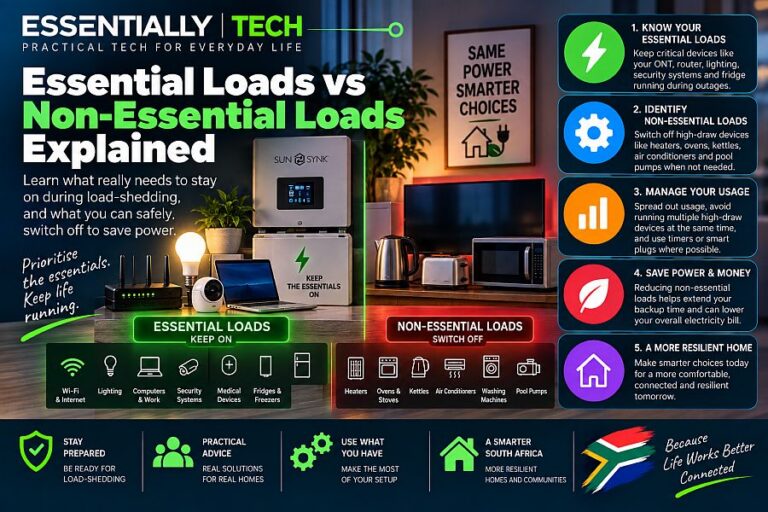
TV and entertainment systems, office equipment, printers, chargers, heaters, fans, decorative lighting, outside lighting, water features and other equipment with predictable usage patterns.
South African government energy-saving guidance specifically recommends avoiding unnecessary standby consumption.
An energy-monitoring smart plug is particularly useful here because it replaces guessing with measurement.
You may discover that the device you were obsessing about costs almost nothing — while something else has quietly been eating kilowatt-hours every day.
Measure first. Automate second.
5. One More Easy Win: Think About How You Cook
You can’t sensibly put your oven on a smart plug, but you can reconsider when you need to use it. For smaller meals, an air fryer can often use less electricity than heating a full-size oven because it heats a much smaller space and generally reaches cooking temperature faster.
That doesn’t mean an air fryer magically uses less electricity for every recipe. If you’re cooking a large family meal, the oven may still make more sense.
But heating a large oven to cook two chicken breasts?
That’s precisely the sort of job where the smaller appliance has an advantage.
6. A Simple South African Smart-Energy Plan
| Appliance | A Sensible Starting Point | Why |
|---|---|---|
| Geyser – grid | Heat around actual hot-water demand | Reduces unnecessary reheating |
| Geyser – solar | Move heating into strong PV-production hours | Uses solar directly instead of stored battery energy |
| Pool pump – grid | Run only as long as your pool requires; avoid evening peak | Cuts unnecessary runtime |
| Pool pump – solar | Schedule during daylight PV production | Reduces grid/battery consumption |
| Lights | Sunset/sunrise or occupancy schedules | Prevents forgotten lights |
| Heaters/Fans | Timed operation where appropriate | Prevents accidental all-day operation |
| Entertainment/office equipment | Switch off automatically overnight | Reduces unnecessary standby usage |
The goal isn’t to find a magical schedule from the internet.
It is to make your home’s electricity use intentional.
Essentially: The TL;DR
Automate what you forget. A smart switch can’t make an appliance more efficient, but it can stop it running when you don’t need it.
Match heavy loads to solar. If you have PV, use appliances such as geysers and pool pumps when the sun is supplying the energy rather than unnecessarily drawing from your batteries later.
Avoid unnecessary overlap. Particularly on inverter systems, don’t have every large load start simultaneously.
Measure where you can. Energy-monitoring smart plugs can show you where the electricity is actually going.
Start small. You don’t need to automate your entire house. One correctly controlled appliance that previously ran unnecessarily can justify the exercise.
And perhaps the most important rule:
A smart switch is only smart if it’s correctly rated for the job.
Plug-in smart sockets are suitable for many ordinary appliances, but a geyser is not an ordinary plug-in appliance. Geysers and other high-current fixed loads require appropriately rated switching equipment and proper electrical installation. Eskom likewise warns against overloaded plugs and unsafe electrical connections.
If in doubt, get a registered electrician to install the controller.
Disclaimer: This guide is intended for general energy-saving and home automation informational purposes only. Heavy-duty appliances like geysers require specialised high-amperage smart switches (typically 20A or 30A) installed inside the distribution board. Always employ a certified, registered electrician to install heavy-duty smart controllers.
“Got solar? Think of your geyser as a giant hot-water battery. Instead of storing every spare watt in your lithium battery and using it to heat water later, use surplus daytime solar to heat the water directly. You’re storing energy as heat — and saving your battery for the things that actually need electricity after sunset.”
— Essentially